What commodity finance is
You cannot evaluate Doré without first understanding the industry it operates in. This section teaches that industry — briefly, but structurally — before any page describes the protocol. Read these five pages in order and the litepaper will read as a set of engineering choices rather than assertions.
The one-sentence definition
Commodity finance is the business of transforming messy real-world trades into claims that specific balance sheets are willing and permitted to hold.
Both halves of that sentence carry weight. Willing is an economic judgment — is the risk worth the return. Permitted is a mandate, regulatory and operational judgment, and it is the half that outsiders consistently underestimate. A great many trades die on permitted while being perfectly attractive on willing.
It is a network, not a loan
The intuitive picture — a lender and a borrower — is wrong, and the error is expensive. Commodity finance is a network of actors each controlling a different scarce capability. Capital reaches a trade only after passing through a chain:
real trade → origination → underwriting → control / protection → capitalEach arrow is a place a transaction can die. And the capabilities are not equally scarce, which is the single most useful thing to know about this industry:
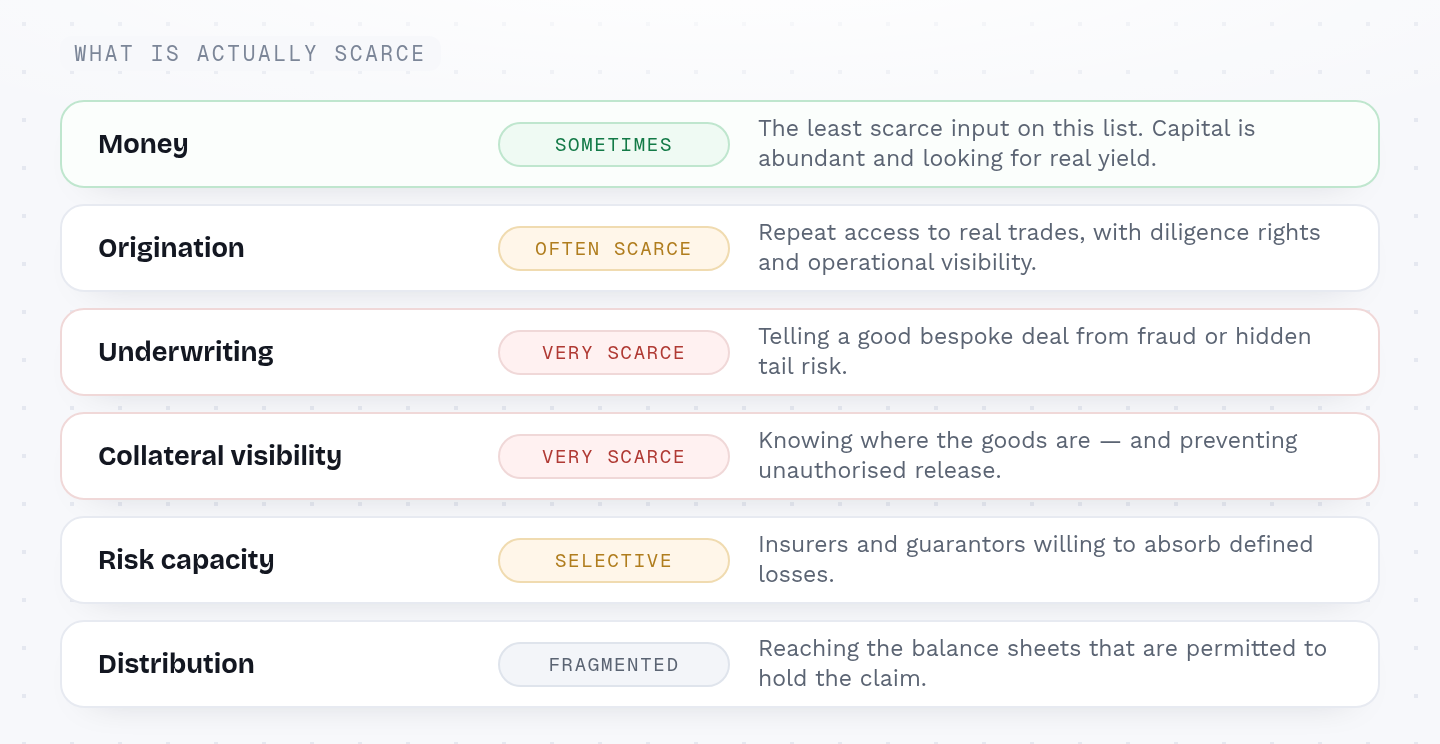
Money is the least scarce input on that list. Any strategy premised on "bringing capital to commodity finance" is competing in the one category with the least shortage. The scarcity is in verification.
Why good trades go unfunded
A market gap is not "people need money". It is a repeatable reason why economically attractive transactions fail to reach willing capital. Four failure modes account for nearly all of it:
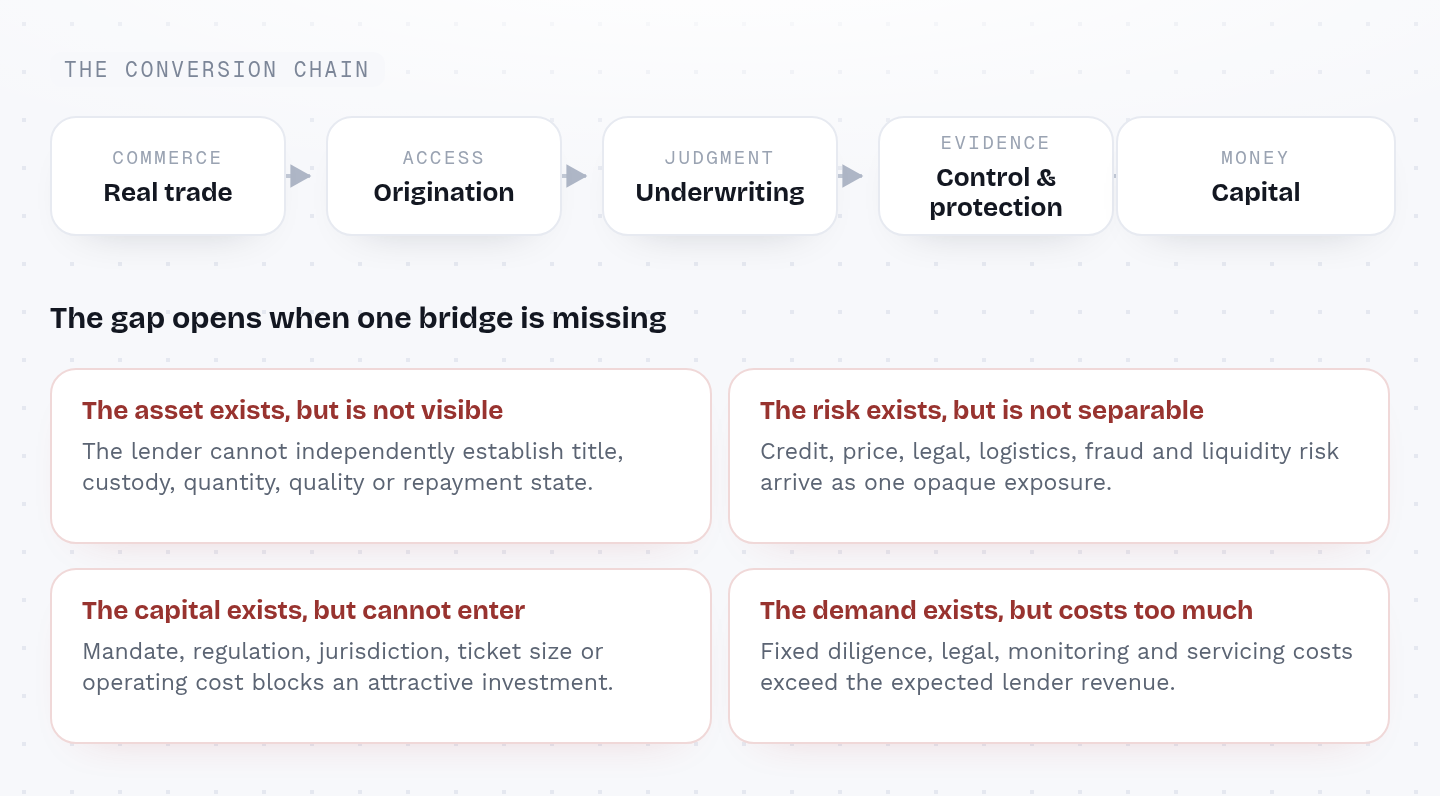
The last one deserves emphasis because it is the least discussed and the most tractable. Bespoke finance has a minimum economic ticket size. A trade can be genuinely profitable, genuinely low-loss and still unfundable because the cost of structuring and monitoring it exceeds what the facility earns. Lower that marginal cost and you do not merely move existing loans onchain — you create financeable supply that did not exist before.
The opportunity is the conversion layer between a real transaction and a financeable claim.
Three distinctions worth memorising
Profitability is necessary; financeability is constructed. A trade does not become fundable by being good. Someone has to build the evidence, the security and the legal wrapper that make it holdable.
Institutional rejection is not economic rejection. A bank declining on jurisdiction, ticket size or workflow is saying nothing about risk-adjusted return. Institutional rejection is the softer target of the two, because it can be addressed by construction rather than by better luck.
Opacity is itself a price. A lender facing unverifiable state prices two things: the economic risk, and the uncertainty about whether reported state is true. The second premium is pure friction, and it is recoverable.
Time is part of price
A borrower may rationally pay a higher annualised rate for capital that arrives immediately on a short, profitable trade. This is not irrationality or desperation — it falls directly out of return on capital, which is margin per cycle times turns per year. Capital that arrives in three days and capital that arrives in three months are different products at different prices, even at the same rate.
This is why the pipeline page treats cycle length as a first-class economic variable rather than an operational detail.
Scope discipline
One warning the source curriculum is emphatic about, and this documentation follows. The broad trade-finance gap is not the commodity-finance addressable market. Global trade volume, total trade-finance instruments, and unmet trade-finance demand are three different numbers, and none of them is the market for any given protocol.
No authoritative global commodity-finance figure appears in our sources, so none appears in this documentation. The honest addressable market is the subset of transactions that can actually be verified, legally structured, priced, monitored and funded through a system — which is a construction problem, not a market-sizing exercise.
Where to go next
| Page | What it covers |
|---|---|
| The commodity pipeline | The physical and financial chain, stage by stage, with the formal coverage of each |
| Financing instruments | The structures, organised by what they finance and where repayment comes from |
| Risk, collateral and protection | The risk taxonomy, the security stack, and what insurance does and does not do |
| Who finances what | The capability map and a sourced map of the institutions active in each layer |
| Onchain | What tokenization does and does not transfer, and the DeFi primitives underneath |