What happens to your money
This page follows a dollar from subscription to redemption, naming at each step who holds it, what legal instrument it has become, what could fail, and which contract call or provision governs it. It is written for someone deciding whether to allocate, not for someone deciding whether the idea is interesting.
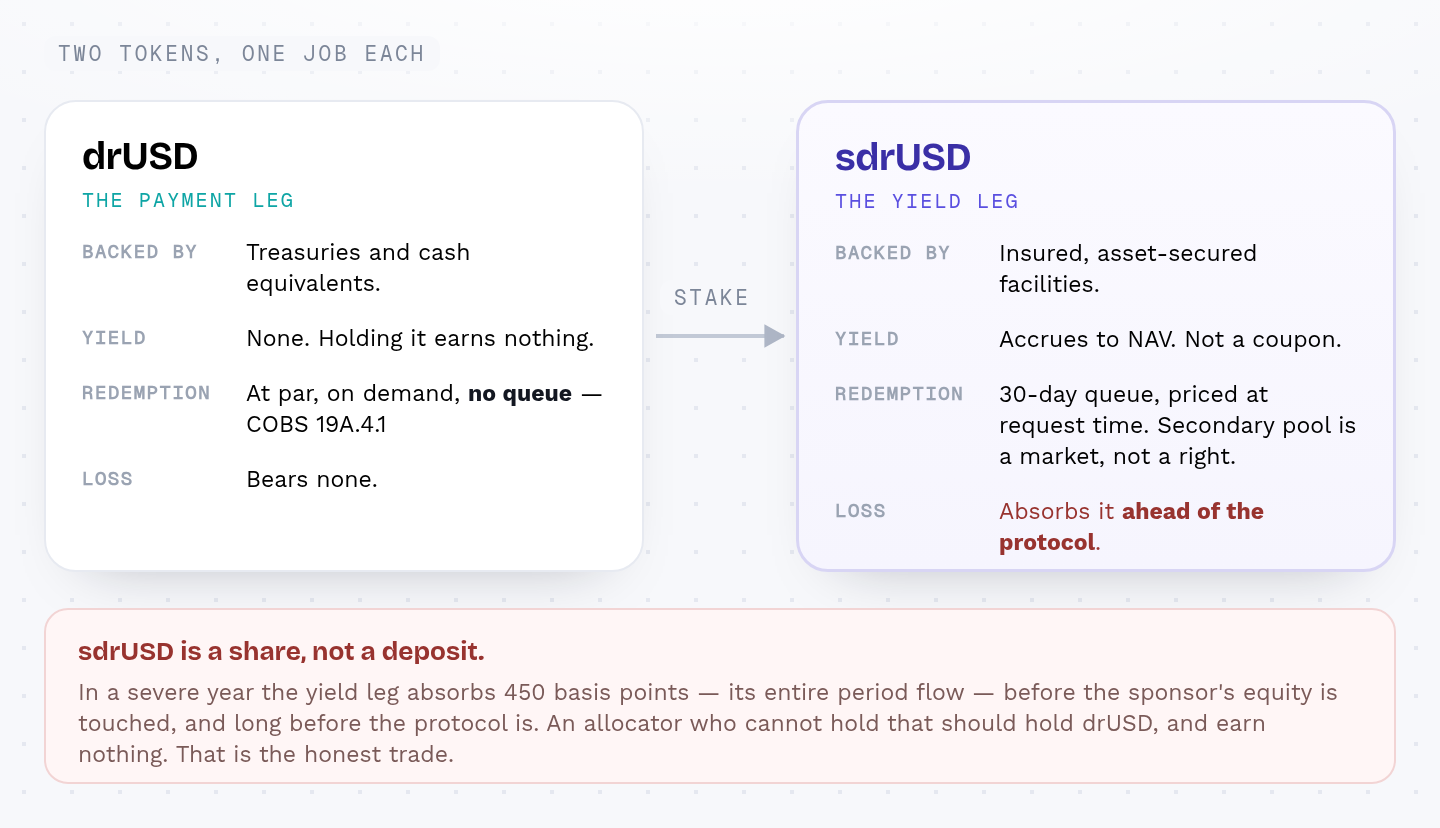
The journey, in eleven steps
1 · You subscribe. You send USDC and receive drUSD at par. drUSD is a
fiat-referenced token backed by treasuries and cash equivalents — not by
commodity credit. At this point you have taken no commodity exposure at all.
Governed by: COBS 19A. Contract: DrUSD.mint, which reverts if the mint
would break backing.
2 · You choose exposure, deliberately. Holding drUSD earns nothing.
Staking it into sdrUSD enters the financing strategy. This is a separate,
explicit act — the product never converts your payment instrument into credit
exposure silently. Contract: SdrUSD.stake, which mints shares at the
current net asset value.
3 · The vehicle acquires a claim — one claim. A single-purpose ADGM vehicle acquires one identified facility — and only one. It issues its own debenture against it. You never hold the underlying facility; you hold a share whose value derives from that debenture. Why one vehicle: pooling triggers the fund regime.
4 · The facility funds metal, and nothing else. Proceeds buy physical commodity. Not proprietary positions, not general corporate purposes. The metal bought with the money becomes the collateral pool.
5 · Control is established before value is advanced. The goods sit in
approved custody, and the advance is limited to a fraction of eligible
collateral — the rest is haircut, absorbing price moves, liquidation cost and
assay differences. A second pledge over already-pledged stock is refused
outright, as is a pledge over stock that does not exist. Proved:
whr_double_pledge_rejected, whr_phantom_stock_pledge_rejected.
6 · Monitoring runs continuously. A monitoring firm the insurers approve,
paid for by the borrower, verifies the collateral pool. Verdicts are computed
from settlement receipts rather than from self-reported state, so a violation
cannot be laundered by reassigning a beneficiary or discharging the obligation
elsewhere. Proved: link_verdicts_immune_to_world_events.
7 · The trade completes and the coupon settles. Metal is refined and sold;
proceeds repay. A settlement cannot be booked before its due time, and cannot
be booked twice. Proved: settlement_never_premature. Contract:
FacilityRegistry.settle, which writes an append-only receipt.
8 · Cash reaches the pool before NAV moves. The vault books the coupon only
against cash it has actually received. We got this wrong once — an early
version credited NAV without receiving the cash, inflating the share price out
of nothing — so the contract now transfers before it accrues, and a test guards
it. Contract: SdrUSD.accrueSettled; invariant nav() <= backing() along this path.
9 · Your share appreciates. sdrUSD does not pay a coupon. It is a share whose NAV rises as settlements accrue. This distinction is legal as well as economic: a fixed rate would make you a creditor, and you are not one.
10 · You exit — by one of two routes, which are not equivalent.
Primary: request redemption and claim after the queue, matched to the
facility repayment cycle. Your redemption is priced at request time, so a
later loss cannot claw it back. Secondary: sell into the pool at market,
immediately, at whatever the market pays — which may be below NAV.
Contract: SdrUSD.requestRedemption then claim; previewRedeem prices it.
11 · If something fails, the waterfall runs. Holders are paid first, capped
at par, before general creditors receive anything. The distribution conserves
the pool exactly. Provision: COBS 19A.11.4. Proved:
frt_distribute_holders_first_par_capped.
Where you sit in the capital stack
The most important sentence in this documentation, for an allocator: sdrUSD absorbs loss ahead of the protocol.
It is a pro-rata share, not a deposit and not a coupon.
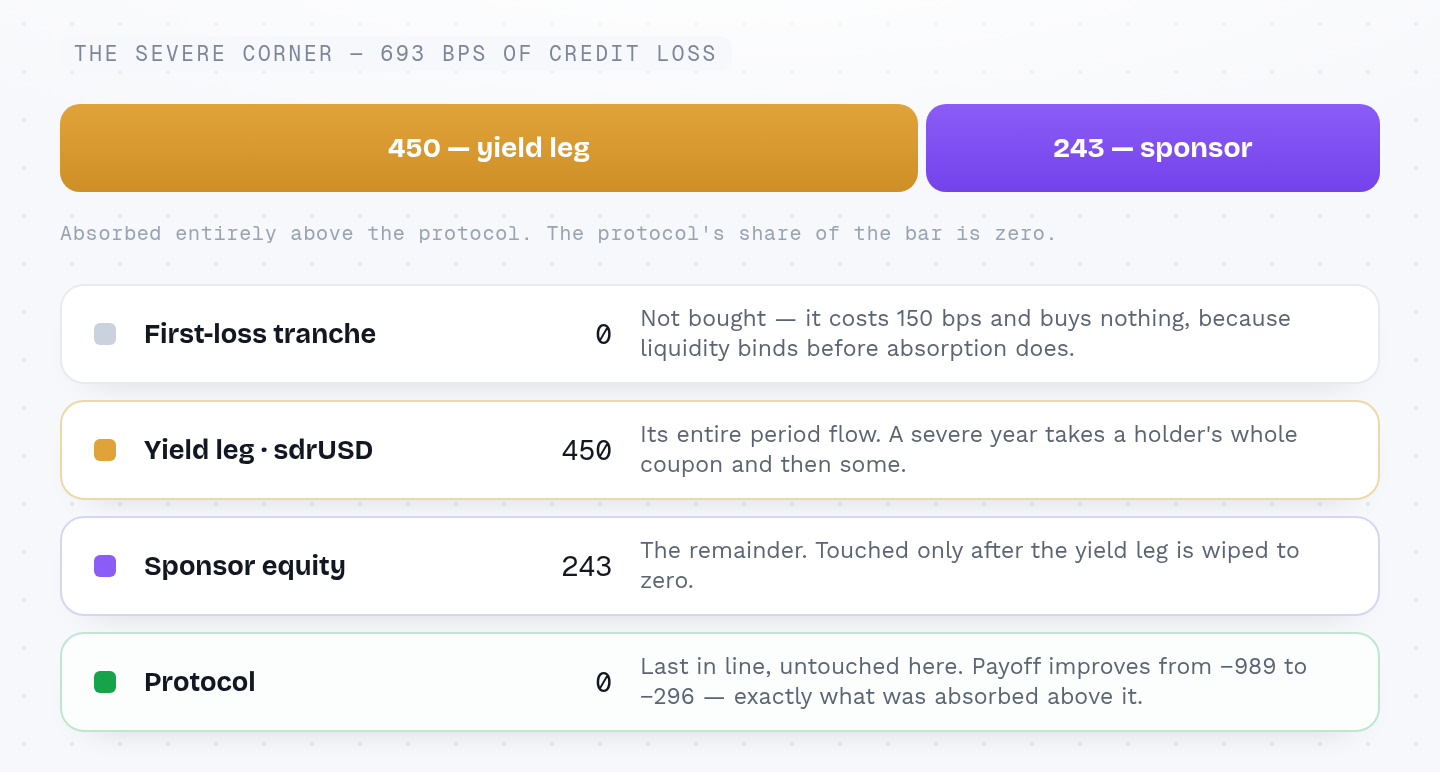 In a severe year the
loss routing puts 450 basis points on the yield leg — its entire
period flow — before the sponsor's equity is touched and long before the
protocol is. An early version of our own model got this backwards, paying
holders a fixed rate and quietly making them creditors. The contracts implement
the share.
In a severe year the
loss routing puts 450 basis points on the yield leg — its entire
period flow — before the sponsor's equity is touched and long before the
protocol is. An early version of our own model got this backwards, paying
holders a fixed rate and quietly making them creditors. The contracts implement
the share.
If you require an instrument that does not absorb loss, the correct instrument is drUSD, and it pays nothing. That is the honest trade and we would rather state it here than have you infer it later.
What each party is obliged to do
| Party | Obligation | Enforced by |
|---|---|---|
| The borrower | Service the facility; pay for monitoring | Facility documents; counter-indemnity |
| The custodian | Hold goods; release only against authorised instructions | Custody agreement; control package |
| The monitor | Verify the collateral pool independently | Appointment by the insurers |
| The issuer | Maintain backing at all times; value daily; notify breaches | COBS 19A.7.1–.7.3, to the FSRA |
| The attestor | Confirm reserves monthly, including a random-day test | COBS 19A.9.1(b)(iv) |
| The auditor | Test reserve composition and controls annually | COBS 19A.10 |
| The protocol | Publish reserve state; never book NAV it does not hold | Contract invariant; verification |
The four questions to ask us
If you are diligencing this, these are the questions that actually discriminate, and each has a page answering it:
- Does the reserve exist and match supply, and can I check without you? → Verify the reserve
- What is the legal wrapper, and is it licensed? → The ADGM position and why one SPV per claim
- Where does the yield come from and is the margin achievable? → How Doré makes money
- What do I lose in a bad year? → Risks and default and workout
- What am I actually funding, and on what terms? → The first facility and fees and terms
- Who can change the deal after I am in? → Governance
What is not yet true
Nothing is deployed to any chain. No attestor or auditor is engaged. No FSRA authorisation is in place. The mechanics above are implemented and tested in Solidity and proved in Lean, and the legal route is sourced — but this is a design you are diligencing, not a live system with an operating history. The roadmap states what has to become true.