Onchain
This page covers the part of the subject that is genuinely new: what happens when a commodity facility is represented onchain, which DeFi primitives it meets there, and — the question that matters most — what tokenization does and does not transfer.
The skeptic's challenge, stated properly
Tokenization by itself does not create liquidity.
The equation private loan + ERC-20 = liquid RWA is false, and any design that depends on it fails. Wrapping a claim changes its representation, not its enforceability, its verifiability, or the existence of a buyer.
What DeFi does well is act after the real-world asset has become a credible, enforceable, monitorable claim. Then it makes that claim easier to fund, transfer, tranche, refinance and compose. It is a weak fit, by itself, for title, inspection, legal perfection, assay, sanctions screening and enforcement — the entire truth layer.
The corollary is the design rule: DeFi does not make a bad or unverifiable asset good. It makes a good verified claim easier to fund.
Three kinds of truth, never to be mixed
This is the most useful distinction in the whole subject, and it determines what any onchain system may legitimately claim:
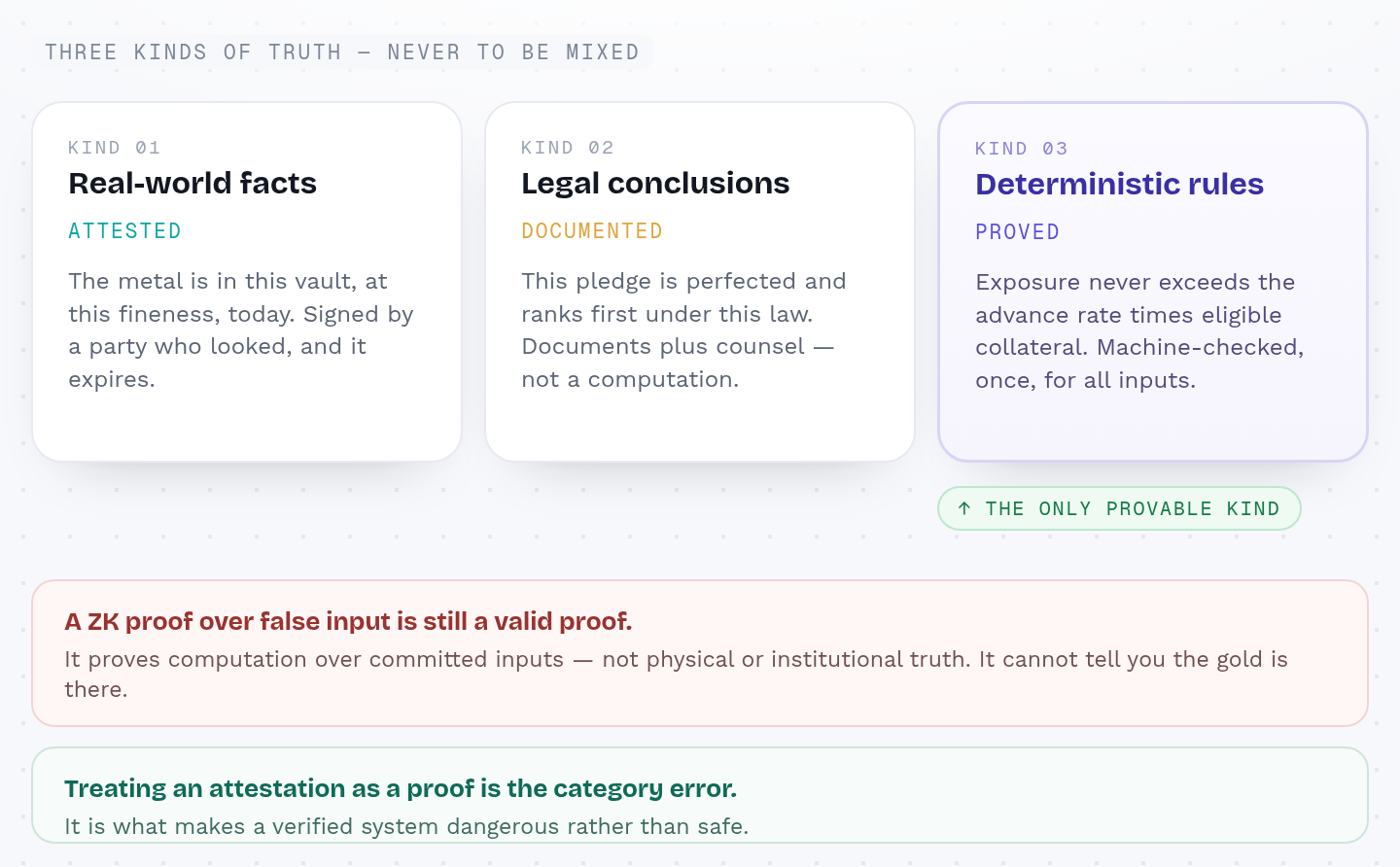
Only the third is provable. Treating an attestation as a proof, or a legal opinion as a computation, is the category error that makes verified systems dangerous rather than safe.
Two consequences follow immediately.
A zero-knowledge proof over false input is still a valid proof. ZK proves computation over committed inputs — not physical or institutional truth. It cannot tell you the gold is there.
Attestation freshness is first-class. An attestation carries an expiresAt : Option Time, and authorisation is
gated on the world clock still being inside it — stale evidence removes
permission automatically rather than raising a flag. In the Doré kernel this is
stale_evidence_cannot_authorize.
What formal verification is actually for
Formal verification and simulation solve different problems. Simulation estimates uncertain reality. Verification proves the consequences of supplied assumptions and authenticated facts. Neither substitutes for the other, and a perfectly verified protocol can still lose money — correctness is not economic judgment.
The right targets are deterministic rules: issuance caps, advance and LTV limits, waterfall priority, draw gating, concentration caps, mandate checks, claim lineage and reuse limits, state-transition permissions. The wrong target is the economics of a five-year note. The best first target is a draw-gating state machine.
And the proof obligation must expose its assumptions rather than axiomatize physical reality. A system that assumes the metal exists has proved nothing about the metal.
The DeFi primitives underneath
These are execution layers. None of them can verify offchain reality — which is precisely why a verification layer sits before and above them.
Isolated lending markets. A market is a tuple of collateral asset, loan asset, liquidation loan-to-value, oracle and interest-rate model. If debt rises past the permitted threshold relative to collateral value, the position is liquidated. Isolation solves risk containment — one bad market does not infect another. It does not solve valuation or exit: liquidation can be theoretical without a buyer.
Curated vaults. Depositors supply one asset; a curator allocates across approved markets and adapters subject to caps and risk identifiers. This moves the underwriting question from the depositor to the curator; it does not remove it.
Shared liquidity layers. Lending, vault borrowing and exchange liquidity drawn from one foundation, enabling high loan-to-value on suitable collateral. Efficiency, not safety.
Yield tokenization. A yield-bearing token is standardised and then split into a principal claim (bought at a discount, redeemable at maturity) and a yield claim. This transforms the yield claim — it does not remove liquidity or credit risk from it.
Leverage, and the metric that keeps it honest
Recursive borrowing — deposit, borrow, redeposit — inflates headline totals without financing a single additional trade. The discipline is a rule and a metric.
The rule: leverage is a distribution feature. It must never be the reason the underlying credit appears solvent.
The metric: real deployed capital — the capital actually financing commodity transactions — reported separately from total value locked and from gross leveraged exposure. Twenty times TVL is not twenty times commodity financing. Reuse is economically productive only when the borrowed capital funds a new independent trade.
The related discipline on the claim side: every derived position must carry lineage back to the underlying claim, and multiple representations of the same claim must never be treated as independent collateral. This is the onchain form of the double-pledge fraud from the risk page, and it deserves the same intolerance.
Comparable structures
A recurring pattern across credible RWA designs is a two-token split: a liquid, non-yielding dollar unit backed by cash-equivalents, and a separate staked, yield-bearing token carrying the credit exposure. Redemption terms differ sharply between the two — the liquid unit at par on demand, the credit token subject to cooldowns, queues or actuarially defined liquidity limits.
Doré's drUSD and sdrUSD follow that shape deliberately. The closest end-to-end precedent in the market takes an awkward offchain asset, standardises it into secured credit, wraps it as a yield token and then places it in a liquidity venue. Commodities are materially harder than that precedent's collateral, because the facts are private, moving and jurisdiction-dependent — which is the entire argument for building the verification layer first.
What this implies for the design
The scarce work is the adapters, not the contract. Standardising the machine-readable interface above heterogeneous legal contracts is the difficult, defensible part. The token is the easy part.
Own the semantics; keep every regulated or physical partner replaceable. The trust boundary is explicit: partners enforce offchain — perfecting and releasing liens, moving commodity, transferring title, collecting payments, filing insurance claims, seizing collateral, running KYC. The protocol owns orchestration and meaning.
Tokenization does not remove the securities layer. Under any serious regulator, a tokenised debt claim is still a debt claim. The legal position page states where that leaves us, on sourced text.