Why one SPV per claim
Every financial claim in the instrument catalogue — a letter of credit, a receivable, a warehouse receipt, a metal stream, a participation — is a different legal animal, governed by different law, in a different jurisdiction, with different transfer mechanics. Tokenizing each one directly would mean solving that legal problem once per claim type, forever.
The ADGM special purpose vehicle is what makes that unnecessary. It is the adapter: heterogeneous claims go in, one uniform investor-facing instrument comes out. And the choice to use one vehicle per facility, rather than one pooled vehicle for many, is not a preference. It is what keeps the structure out of the fund regime.
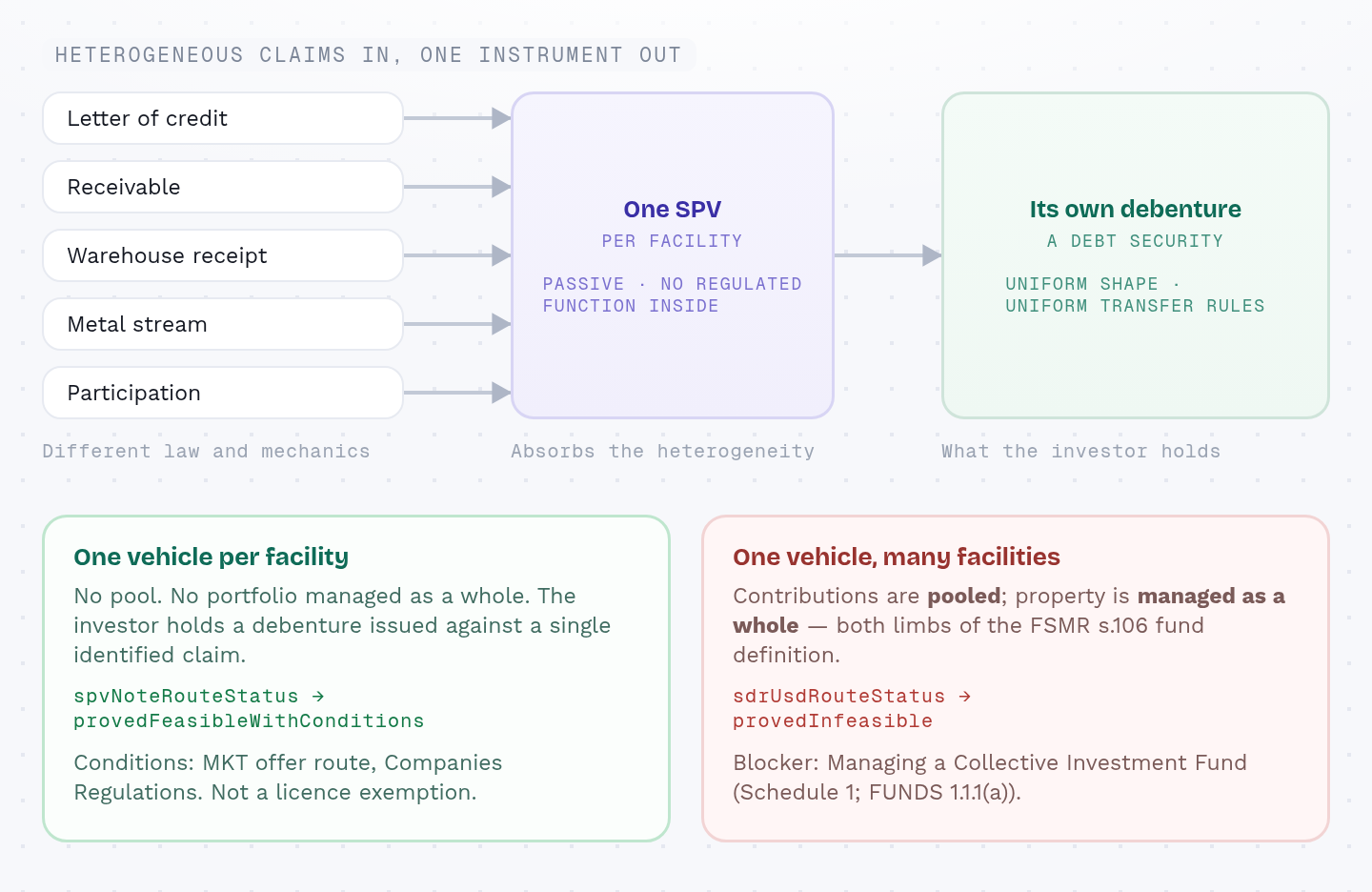
The adapter pattern
The SPV does two things and nothing else:
- It acquires the claim. Whatever the underlying is — a credit-linked note, a revolving loan, secured project debt, a discounted receivable — the vehicle takes ownership of it under its own governing law, with security perfected wherever the collateral sits.
- It issues its own debenture against it. The investor never holds the underlying claim. They hold a debt security issued by a vehicle whose only asset is that claim.
All the legal heterogeneity is absorbed at step 1, which is a private acquisition governed by the underlying's own law. Step 2 is uniform: the same instrument shape, the same transfer rules, the same disclosure, every time. That is why the corpus can carry 101 different archetypes and still present one token — the variety lives below the vehicle, not above it.
This is also why the claim schema matters more than the token contract. The scarce work is the adapter that turns this particular facility into the canonical shape. The token is the easy part.
Why not one SPV holding many facilities
Because pooling is the exact trigger for fund analysis.
FSMR section 106 defines a Collective Investment Fund by cumulative limbs. The two that matter here are that contributions are "pooled", and that the property is "managed as a whole by or on behalf of the Fund Manager". Units in a Collective Investment Fund are Securities under FSMR Schedule 1, and Managing a Collective Investment Fund is itself a Regulated Activity requiring permission.
A token backed by many facilities held in one vehicle satisfies both limbs almost by construction. Contributions are pooled; the portfolio is managed as a whole. At that point the structure is a fund, and the fund regime attaches in full:
| Obligation | Provision |
|---|---|
| Fund manager permission | FSMR Schedule 1 |
| The Managing a Collective Investment Fund activity gate | FUNDS 1.1.1(a) |
| Units offered only by exempt offer, to professional clients, above a minimum subscription | FUNDS 3.3.4 (with 15.1) |
| Those conditions maintained on an ongoing basis | FUNDS 15.1.2 |
| Notification of the Regulator on the qualified-investor route | FUNDS 6.2.2 |
| Legal title to fund property held with an eligible custodian | FUNDS 15.3.1 |
| Management strictly per the constitution and prospectus | FUNDS 12.2.1 |
Our own formalization lands exactly there. On today's facts the pooled route
evaluates to provedInfeasible with the blocker named in full — Managing a
Collective Investment Fund (FSMR Schedule 1; FUNDS 1.1.1(a)). Not a warning: a
closed route, until the permission exists.
The single-vehicle route, and what it actually buys
Put one facility in one passive vehicle and the analysis changes. There is no pool. There is no portfolio managed as a whole. What the investor holds is a debenture — a debt security — issued by a vehicle whose sole asset is a single identified claim.
The formal route in the development is spvNoteRouteStatus, and it turns on
three conditions, each of which can fail:
- The vehicle is passive. No regulated function is performed inside the
SPV. If it is not, the route is
provedInfeasiblewithspvActivityNotPermitted— this is the condition that fails first and hardest. - The notes are Securities. If the instrument falls outside the Security
paragraphs the route returns
unresolvedInterpretationand needs re-analysis rather than a workaround. - Every regulated function sits in a permitted entity. Arranging, custody and management happen around the vehicle, in entities that hold the relevant permissions.
With all three satisfied the route resolves to feasible with conditions — the conditions being the MKT offer-route obligations and the Companies Regulations provisions.
What this route does not do
It would be easy to read the above as "no licence required". That reading is wrong, and the project's own analysis says so directly: the thesis is narrower than that. An own-debenture exclusion may cover the issuance, while the offer, custody and trading rules still apply in full. The offer leg is anchored at MKT 4.3.1(1) — the exempt-offer route — not waived.
Three further cautions, stated because a reader will otherwise supply the optimistic version:
Classification depends on substance, not labels. A single-issuer debenture structure can sit outside the Fund definition in specified circumstances, and whether it does depends on the actual terms. Calling a vehicle passive does not make it passive.
Tokenization does not remove the securities layer. A tokenised debenture is still a debenture. Digital-securities guidance applies on top, not instead.
Secondary transfer is a separate question. Do not assume permissionless transfers; whitelisting and eligible-venue treatment have to be designed and cleared, and the venue analysis is its own route.
The consequence for the product
This is why the two tokens are shaped the way they are. The payment leg is a fiat-referenced token governed by COBS 19A, backed by treasuries and redeemable at par. The yield leg is a claim on facility economics — and it is legally far cleaner as one facility's debenture than as a share in a pooled multi-facility vehicle, which re-creates the fund analysis the single vehicle exists to avoid.
Scaling therefore means more vehicles, not a bigger one. Each new facility gets its own SPV and its own note; the uniform investor instrument is what composes, not the underlying pool. That is a slower structure to build and a much easier one to defend — and it is the honest reading of what the ADGM regime permits today.
Every provision cited on this page is sourced and hashed, and the ADGM position records which routes resolve and which remain open.